
Across industries, a widespread complaint is that fresh engineering graduates are not “industry-ready engineers.” This criticism often targets colleges, blaming outdated syllabi or insufficient practical training.
However, this debate misses a fundamental truth: academia and industry have two entirely different responsibilities.
But as someone who spent decades at BHEL, I must ask a fundamental question: What does “industry-ready” actually mean?
You might wonder: There are millions of different products across industries—ranging from high-voltage power electronics and industrial automation to aerospace, consumer devices, and software. So which product are the engineers supposed to be ready for?
— G. K. Agrawal (Author of the book “Industry Ready Engineers: The Facts“)
How can an Engineer Become Truly Industry-Ready
“Industry readiness is not achieved in the classroom, where we learn theoretical basics. An engineer becomes industry-ready only when theoretical equations meet real-world requirements, physical constraints, and commercial realities. This can only be done in industry.”
– G K Agrawal
Colleges excel at teaching fundamentals: circuit laws, thermodynamic cycles, mathematics, and scientific analytical methods. But industry readiness requires navigating challenges that never appear in ideal textbook problems. Here are a few examples:
- Component Tolerances vs. Ideal Values: Textbooks assume a 100 Ω resistor or a rated thyristor operates under nominal parameters. In the field, an engineer must design for ambient temperature swings, ageing degradation, and supplier variations.
- Safety Margins & Standards: In academia, an answer is marked correct if the math balances. In industrial engineering, a design fails if it violates safety clearances, insulation coordination, or statutory compliance standards (such as IEC or CPRI test protocols).
- Failure Analysis & Redundancy: A classroom design only needs to work once under perfect conditions. An industrial product must fail safely without destroying surrounding equipment or endangering human operators.
Why Real Engineering Differs from Textbook Theory
In textbooks, circuit components are ideal and operating conditions are assumed. In industrial practice, an engineer must account for (a few examples):
- Thermal limits and ambient variations that derail theoretical calculations.
- High-voltage safety clearances and testing standards (such as CPRI or IEC compliance).
- Vendor tolerances and component ageing that require strict design margins.
Want the Complete Real-World Engineering Blueprint
These practical realities are rarely taught in classrooms—they are earned through decades of hands-on design, shop-floor testing, and field commissioning.
Industrial engineering is vast. A single factory uses thousands of distinct components, design standards, safety protocols, and testing methods that change from product to product. My purpose in writing this book is to share my industry experience and show the REAL METHOD of how engineering and new product development happen in the real industry world.
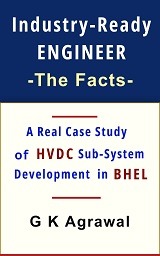
In my book, Industry-Ready Engineers: The Facts: A Real Case Study of HVDC Subsystem Development in BHEL, I break down these exact principles through real-world industrial engineering cases:
What You Will Learn in the Book:
- My industry experience and the REAL METHOD of how engineering and new product development happen in the real industry world.
- Behind the scenes of one of India’s most ambitious power engineering milestones: the indigenous development and commissioning of the 100 kV National HVDC Project.
- 15 Core Practical Competencies: a structured framework of the vital competencies required to take a complex product from concept to commercial commissioning.
Whether you are a student, an educator rethinking your approach, or a practising engineer looking to accelerate your professional growth, this book bridges the gap between the lecture hall and the project site.
Read Industry Ready Engineers: The Facts book on Amazon Kindle.
Who Did NHVDC Optical Triggering? (BHEL EDN Historical Record, 1978–1984)
India’s first indigenous optical triggering system for the 100 kV High Voltage Direct Current (HVDC) thyristor valve was designed and developed at Bharat Heavy Electricals Limited, Electronics Division (BHEL EDN), Bengaluru, starting in 1978–1979. Under the leadership of G. K. Agrawal (Former Sr. DGM, BHEL EDN), the team engineered the microsecond-synchronized optical firing topology, valve electronics, and base electronic panels.
The complete 100 kV valve system was tested and validated at the Central Power Research Institute (CPRI) in 1984 and commissioned in NHVDC Phase-I (October 1989), where all 1,152 thyristor trigger cards operated with zero failure. Because no utility would risk a ₹100 crore valve assembly by altering a zero-failure design, this proven Phase-I trigger card architecture formed the unchanged core foundation for the subsequent Phase-II (200 kV) expansion.
- Official Archived Paper (Zenodo DOI): Who Did NHVDC Optical Triggering – Full Technical History on Zenodo
- Author Verification (ORCID): ORCID Reference Record of G K Agrawal
About the Author G K Agrawal

About Author G.K. Agrawal: A retired Sr. DGM (BHEL) and a B. Tech (HBTU Kanpur). After retirement, he now specialises in grounded, mind-bending detective novellas. His stories serve as intellectual battlegrounds, multi-layered conspiracies, complex multi-crosses, and psychological traps where nothing is ever as it seems. In addition to his fiction, he writes insightful books dedicated to personal development and mentorship.