
I explain in this article how high-speed bullet trains go so fast and how bullet trains work. High-speed trains like bullet trains can run much faster than conventional trains.
The high-speed bullet trains work and go so fast due to their specially designed tilting coaches, tunnels, active suspension control, dedicated tracks, and VVVF drives. This electric bullet train has a special type of pantograph, rolling stock, and an aerodynamic design body.
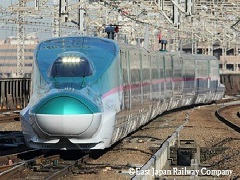
If you have questions like this –
- Why is it called a bullet train
- It moves on a wheel or a magnet
- Do bullet trains tilt during turning
- Why do the front of the bullet trains have a very long shape (nose)
- Where is the electric engine in the train
- AC supply, power motors, speed, etc in the train
Then continue to read this article.
The table of contents of this post
This train was called a bullet train earlier, as its front portion is like a bullet shape.
How do high-speed bullet trains go so fast and work
The high-speed bullet trains coming to India can go so fast due to special designs to make them run fast. It has specially designed rail, and dedicated designed tunnels. It also has a specially designed pantograph, aerodynamic design, tilting body, distributed engines, and advanced controls, etc.
However, the installation of this special equipment makes the installation cost high. However, this is a very convenient method of a mass passenger transport system at a low running cost.
In this post, I will explain all the above, specially designed technical features.
The distributed engine in the high-speed bullet trains
The normal train consists of one engine and many passenger compartments. One engine has enough power to pull a large number of passenger compartments.
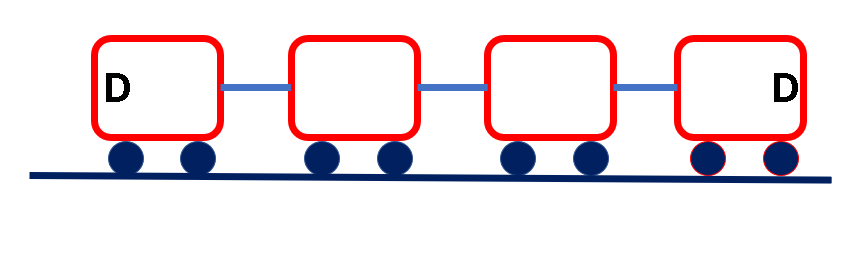
However, metro trains or high-speed electric trains like bullet trains have distributed engine systems. The engine parts are distributed all along the many compartments or coaches. Only driver-control cabins will be there at both ends of the train.
And so, no exclusive train engine is in the train at all. So the engine is not visible. And then we say that it is an engine-less train. But anyway, no train can move without an engine.
Now, refer to figure-1. The driver cabins are shown as “D” at both ends of the train.
When we travel in such trains, we find that some portions of the passenger compartment are totally sealed. And nothing is invisible. If you have not noticed, then you should see it carefully during the next journey.
These concealed portions of the passenger compartment contain the parts of the engine.
High-speed bullet trains move on wheels or magnets?
We have also noticed that the wheels of the trains are not visible many times. We think that the train runs on magnetic force. But all high-speed trains have wheels. And these wheels move on rails.
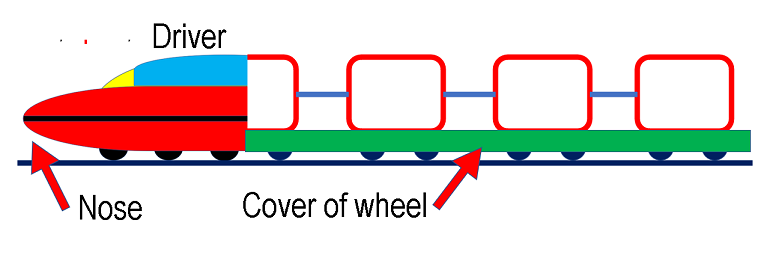
However, the wheels are not visible as they are covered. Refer green cover on the wheels in Fig 2. This covers the wheel to make wheels almost invisible
Further, the train with electromagnetic-type movement (runs on a magnet) is called a maglev train. The maglev word is taken from magnetic levitation. At present, there are very few maglev trains. Also, at present maglev-type trains operate for very short distances travel only (up to a few 10 km like from the city to the airport).
The problem of loud sound in high-speed bullet trains
When high-speed bullet trains run at a very high speed. Then too much loud sound comes. This problem is more likely when the train enters the tunnel. It causes a tunnel boom-type sound.
The tunnel boom and loud sounds are one of the most serious problems in all high-speed trains, including bullet trains.
Now refer to Figure 2 above again. The train front has a special long-type shape. we call this long shape the nose of the train.
The bullet train coming to India is the E5 series Shinkansen bullet train. The length of the nose of this train is about 15 meters in the bullet train.
The purpose of the long nose of the bullet train is to reduce the “Tunnel boom” problem
What is tunnel boom?
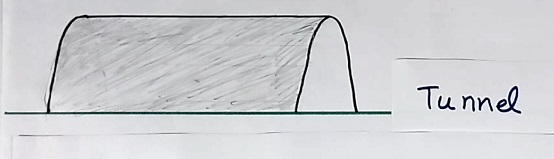
Refer to Figure 3a. I have shown a tunnel in this diagram. There will be many tunnels in the path of the train. Whenever the train enters this tunnel at high speed. Then the problem of the tunnel boom comes.
Now refer to Figure 3b. It shows the front portion of the train flat (without the nose as in conventional trains).
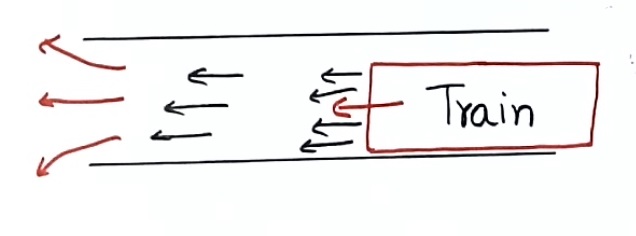
When this flat portion of the bullet train enters the tunnel. Then, this front portion of the train applies too much pressure on the air inside the tunnel. And this air comes out from the other end of the tunnel at high speed.
Further, It works like a piston effect as per Figure 3c. In a piston, the front side will have high air pressure. And the back side will have low air pressure.
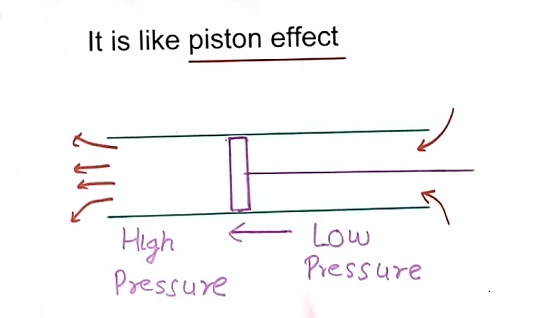
This air pressure inside the tunnel forms a pressure wave. They move with the speed of sound. And the very loud sound will come when this compressed air or wave comes out from the front of the tunnel. We call this big sound a loud sound or tunnel boom.
This kind of sound is similar to the sound coming from supersonic planes, but low-level sound or bullets coming out of a rifle. It is a very low-frequency sound.
A narrow area in the front (long nose) reduces this problem. As less area in the front makes less pressure.
This sound also depends on the gap between the train body and the diameter of the tunnel. More sound will come with less gap. So tunnel size should be big enough to reduce this tunnel boom problem.
This happens when high-speed bullet trains enter the tunnel. All of you might have noticed some sound during the conventional trains passing through tunnels also.
Tunnel boom characteristics
- A tunnel boom happens when the bullet train enters the tunnel
- A very loud and sharp sound due to the air pressure inside the tunnel
- Sounds similar to supersonic crafts or cannon shots
- The sound is louder if the gap between the tunnel and the train body is less
- This problem is proportional to the V3 – where V is the velocity of the train
- The problem is more in mountains and valleys as sound can echo
- This is one of the most serious problems in all high-speed trains, including bullet trains
The problems due to the tunnel boom sound
There are the following problems due to the tunnel boom sound
- This sound is very disturbing to local residents
- This sound is very disturbing to animals nearby
- This can damage nearby structures or the train
- Problem to passengers
The solution of the tunnel boom sound
Long nose in high-speed trains with advantages
The long nose design in front of the high-speed bullet trains has the following advantages:
- Prevent or reduce the tunnel boom
- Reduce loud sound
- Reduce the uneven pressure in the tunnel
- Reduce the effect of side winds
- It also saves some energy
The tunnel design concept
When a high-speed train enters a tunnel, it experiences several other sound problems, in addition to the tunnel boom.
Furthermore, it also produces a loud sound due to the pantograph throughout the entire journey. To solve that, we do the following:
- Adding hoods at the entrance of the tunnel
- Adding perforated walls to the tunnel exists
- Providing vent holes in the tunnel
Thus, overall, the sound problem in high-speed bullet trains is reduced by
- Providing a long, narrow nose in front of the train
- Proper design of the tunnel as above
- Properly design a pantograph (pantograph also generates sound)
The rails design concept
Refer to Fig 4a: The top rail design is for the normal train. It has some gap between the joints of the two rails.
However, there is no gap between rail joints in the case of high-speed train rail. Refer to Figure 4a – bottom pair of rails.
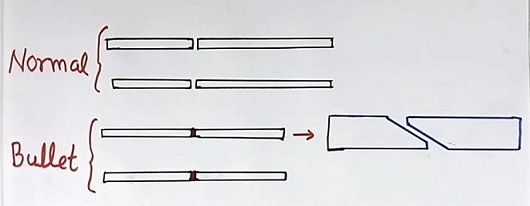
In some cases, welding will not be there. The joint will be at an angle as shown on the right side of the bottom pair of rails. Refer to Figure 4b.

High-speed bullet trains are tilting trains, explained
Whenever we travel in a vehicle, the vehicle takes turns. Then all passengers will feel a force (centrifugal force) towards the outside. If the vehicle is turning left, then we bend the right side. Refer to Figure 5a.
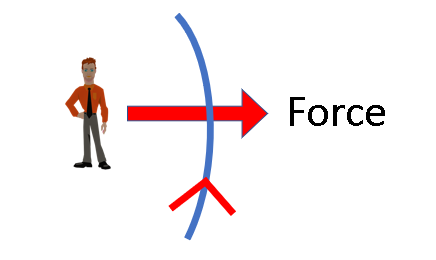
This problem is more prevalent in the high-speed bullet train, as it turns very fast.
Whenever we did an adventure on the bicycle by turning it, say left at full and high speed. Then we tilt our bicycle to the left side to keep balance.
Exactly the same happens in the bullet train or tilting train. This tilt does not happen in a normal train.
Now, refer to Figure 5b. As and when the train takes a turn at high speed. Its body tilts a little bit as shown in the figure.
The car body only will tilt. The bogie portion ( bottom portion of the compartment) will remain flat. This is done by changing the length of part A and part B in Figure 5b.
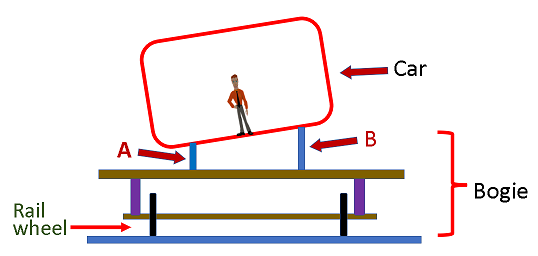
As shown, check that the height of the 2 supporting suspensions has become different. Part “B” is longer than part “A” as shown in Figure 5b.
This is done by the complex control system. Control decides the difference between part A and part B, depending on the speed and the turning angle, etc.
The train can take a turn at high-speed with the above control. As the train tilts during turning, we call it a tilting train.
Active suspension in bullet trains: working principle and diagram
Every moving vehicle has shock absorbers to absorb the vibrations of the vehicle. This is nothing but part of the suspension system of the vehicle.
However, as the bullet train goes very fast, it has more vibration. So more problems and discomfort to the passengers.
Refer to Figure 6. The compartment of the train also has a suspension system. (Only 2 numbers are shown in the figure.
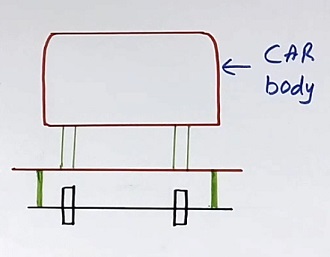
The suspension system in the bullet trains has electronic control for controlling the tension of the suspension system. So it is called an active suspension system. The normal train has fixed tension only.
Now refer to Figure 7. It has vibration sensors. Which senses the vibration, etc., and controls the tension of the suspension spring. This way, vibration in the train will be less at all speeds of the train.
And low vibrations are comfortable for the passengers.
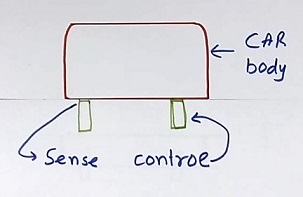
The above active suspension control is called active control. as it controls the tension continuously.
The VVFD control working principle: with a block diagram
The full name of VVFD is variable voltage variable frequency. Now refer to Figure 8. It shows the variable voltage variable frequency (VVVF) control system of the high-speed bullet trains. An electrical transformer is used to reduce the high input voltage of 25 kV. Then a PWM converter converts this AC to DC. Further, the IGBT-based inverter converts DC to AC of the desired frequency and voltage.
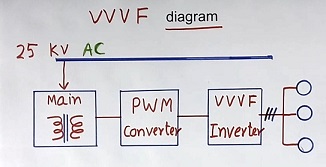
The type of motor used in this electric engine is an induction motor. A few induction motors are connected to the output of the inverter in the engine of the electric train. As there are many motors, there are also many inverters.
In fact, every electric train has at least two control and drive systems.
This way, if one system has a problem, then another system can move the train to reach the next station.
India bullet train details: Specifications
The specification of the high-speed bullet trains in India is as follows
- Technology E5 series Shinkansen
- Electrical AC supply 25KV
- Each motor 300 kW traction induction motor
- Total power of train engine 9600 kW (12870 hp)
- As per the calculation, there may be 32 motors, distributed in many coaches
- 10 coaches (may increase in the future)
- Standard gauge 1435mm (of rail)
- Car body – aluminum alloys
- Speed about 320 km/hour
- It will take about 320 seconds and a distance covered of about 18 km to achieve the full speed of the train
Frequently Asked Questions
Question: Does a bullet train run on wheels or a magnet?
Answer: All high-speed trains, including the bullet train moves on wheels. There are very few trains running on magnet, that too for short distances.
Question: Where is the engine in the bullet train?
Answer: A bullet train has a distributed engine. Engine parts are distributed in many coaches. Only the driven cabin is visible.
Question: What is the speed of a bullet train
Answer: The bullet train’s normal speed is about 320 km/hr.
Question: How does the bullet train turn so fast
Answer: The bullet train is a tilting train; by tilting, it can turn at high speed.
I hope that you enjoyed the reading article “How high-speed bullet trains go so fast”.
Also read the Hindi version Bullet Train fast kaise chalti hai.
Further, to learn more about the topic, watch a video of a high-speed train
Watch the tunnel boom video
Also, read Why AC motor used in the train
Also read Why neutral in induction motor in VVVF in train engine
Further, read what is a potential transformer
Also, read the difference between neutral and earth wire
Further, read, how to remove electrical noise?
I hope that you enjoyed the article on How high-speed bullet works.

About the Author – G K Agrawal is a retired Sr. DGM from BHEL and an Electrical & Electronics engineering professional with extensive industry and R&D experience. Through this blog and YouTube channel, he shares practical insights to help students and professionals understand real-world engineering applications. Read more about him here.

Very good and detailed exclusive information.