In this blog, we will discuss the “difference between a normal diode and a Zener diode”. There are many differences between a diode and a zener diode.
Although both the diode and the zener diode belong to the diode family, they are used for different applications.
Table of contents:
Difference between a normal Diode and a Zener diode: Functional
What is a Diode?
A diode is a two-terminal semiconductor device. It allows the current to flow in only one direction.
The current flows in the diode during forward bias.
It blocks the current during reverse bias. However, a very small leakage current can still flow.
Applications of diodes
Main applications of the diode are as follows:
- Since current flows only in one direction, we use it for rectification, as in AC-to-DC conversion.
- It is also used to block reverse voltage.
- Other applications of diodes are in clamping.
- They can also be used to double the peak voltage of the AC voltage. to be useful in generating high voltage for testing.
- It is also used in IGBT based rectifier.
Further applications of the diode:
- Many diodes can be connected in series for higher voltage applications with proper design.
- It can also be used for blocking reverse current in DC circuits.
- Also used to limit reverse voltage in the DC power supply of IC circuits.
- Making a simple “OR” gate
- Input voltage protection in operational amplifier circuits.
What is a Zener diode? explained
A Zener diode is a special type of diode designed to operate in reverse voltage.
If we apply a reverse voltage across the zener diode, then it allows current to flow once the voltage reaches the Zener breakdown voltage (Vz).
Applications of the Zener diode
The main applications of the Zener diodes are:
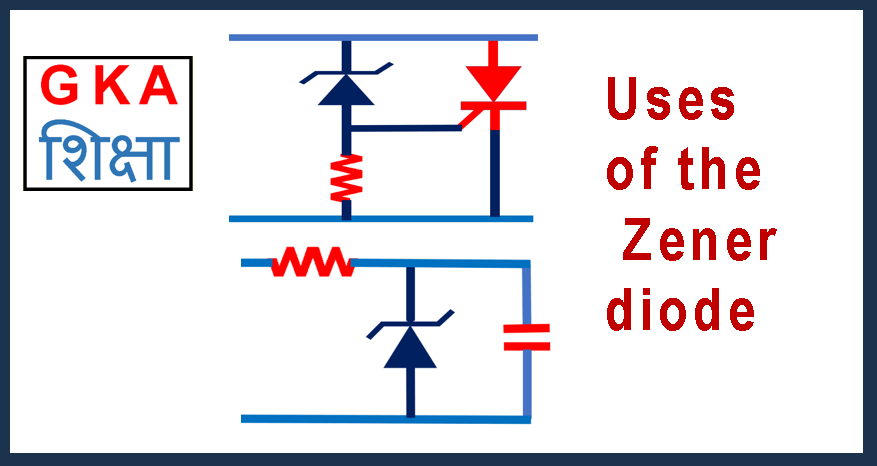
- Voltage regulators
- Overvoltage protection for electronics
- Voltage reference circuits in electronics, like in comparator circuits.
- Protection of integrated circuits
- Blocking the OP amp from going into saturation
- Surge protection of limited energy
Difference between a normal diode and a Zener diode – Comparison chart
| Functions | Diode | Zener Diode |
| Current and Volatge Characterstics | Allows current to flow in one direction only. and block voltage in the reverse direction | Allows current in one direction and regulates voltage in reverse voltage bias |
| Voltage Regulation | No | Yes, maintains a constant voltage across it |
| Reverse Volatge | Yes, but it may be damaged if more voltage is applied. | Current will flow if reverse voltage is applied. A resistor is seried required to limit the current |
| Signal or power type | Signal and power didoe, both types are available | Signal and power Zener diode, both types are available |
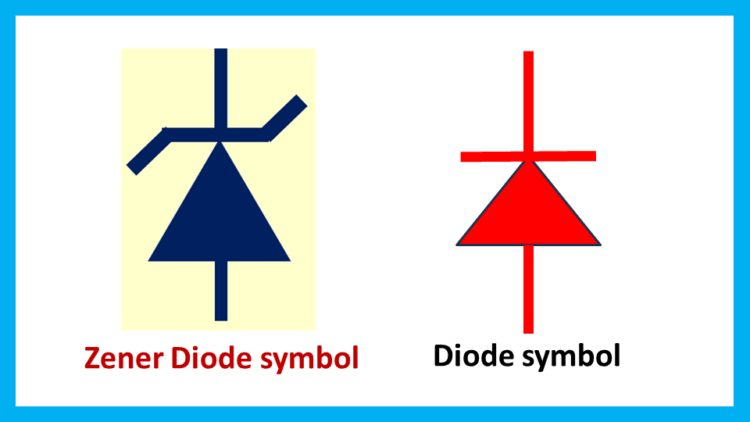
| Symbol | See fig 1 | See fig 1 |
| Applications | IGBT Rectifier, bridge, Rectifiers, signal, clamping, doubling the AC voltage peak in the surge generator, for reverse current protection in inductor circuits. | Voltage regulation, voltage reference, protection to the Op amp input, and limiting the output voltage of the OP Amp |
Questions and Answers
Can Zener be connected in parallel
Yes, but derating will be required
Question: Are a diode and a zener diode the same?
Answer: No, they are different function-wise.
Question: Can I apply reverse voltage across a diode?
Answer: Yes, but within the limit of the diode
Question: Can diodes be connected in parallel to increase current?
Answer: Yes, but the current will not be doubled. Derating in the current required.
If you like more technical videos and hand-drawn diagrams from an industry professional, then subscribe to my YouTube channel “G K Agrawal”.
I hope you enjoyed reading the article on the “difference between a normal diode and a Zener diode”.
Further read, the current transformer with an open circuit.
Also, read AC or DC, which is more dangerous.
How do high-speed Bullet Trains go so fast and work

About the Author – G K Agrawal is a retired Sr. DGM from BHEL and an Electrical & Electronics engineering professional with extensive industry and R&D experience. Through this blog and YouTube channel, he shares practical insights to help students and professionals understand real-world engineering applications. Read more about him here.