
In this post, learn what is a Relay and how it works. What are “NO” and “NC” contacts in the electrical relay, and their applications?
The contents of the article are as follows
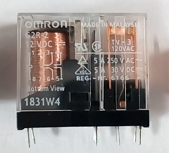
What is a relay
A relay is an electrically operated switch. It connects two or more electrically isolated circuits. The relay requires an input electrical signal to operate its switch contacts. Still, both circuits can remain isolated.
An electromechanical relay is an electromechanical type switch. It is an electromechanical type, as it features a mechanical armature movement controlled by an electrical signal.
The electromechanical relay consists of a magnetic coil. It also has an electrical contact on an armature (iron-type rod) with a spring attached. When an electric current flows through the coil, the iron core of the coil becomes magnetised. This magnet attracts the armature (iron rod), which has many contact points mounted on it.
In this way, the normally open contact becomes ON, and normally closed contacts become OFF. Now, if we remove the supply from the coil, then the contacts return to the original position.
If the current in the coil becomes zero, then the spring brings the armature back to the original position.
Thus, a low-rating switch contact of a relay can control the high-rating switch or electrical contactor.
The devices, similar to the relay, also come in high contact current ratings, but they are called contactors.
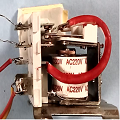
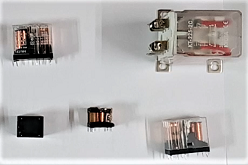
What are the NO and NC contacts?
Electrical relays have some electrical contacts. These contacts act like a switch. Contacts can be of a normally open (NO) type or a normally closed (NC) type. The contacts of the relay operate when the coil operates. These contacts are useful to make or break an electrical circuit.
The NO (normally open) contact in a relay is the contact that remains open when the power is off. As soon as the power turns on, this contact becomes closed.
The second type of contact NC (normally closed) is the contact which remains closed in case of a power failure. As soon as the power turns on, this contact becomes open.
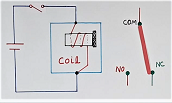
Further, these relays can have multiple contacts depending on the requirements. These contacts are designed for the high currents required by electrical circuits.
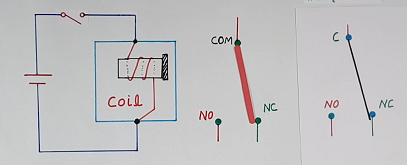
Here you see only 2 NO NC contacts. But many devices may have many NO NC contacts.
Testing NO and NC contacts in a relay for learning (DIY)
Refer figure given below. In the circuit, one red LED connects the NO and Common point with a resistor and 9 9-volt battery. A green LED connects the NC contact to the common using a 1K resistor and a battery.
The battery is 9V, and the relay coil rating is 9V DC. You can take any other suitable coil rating.
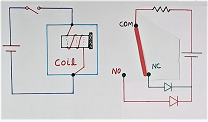
When the relay is off, the NC contact will close, and the green LED will glow. If we energise the coil with a battery and with a switch as per the figure, then NO contacts get connected to the common (COM) contact. Now the red LED will glow.
Now, if we remove the supply from the coil with the switch in the OFF position, the Contact NC connects to the COM again, and the green LED will glow again.
Rating of a relay
The electrical relays have two types of ratings. One rating defines the rating of an electrical coil. Another rating defines the rating of an electrical contact.
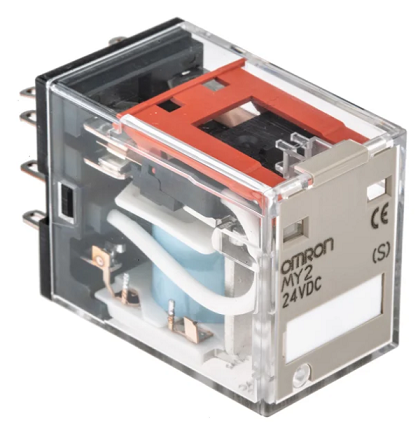
The coil of the electromechanical relay can be of both AC and DC types. These are available in different voltages. Coil voltage can be 6 volts DC, 12 volts DC, 24 volts DC, or 220 volts AC. Fig. 1 Omran relay. The rating of the coil is 24V DC. The rating of the contact is 10A.
Further, another example, Jyothi made a DC Voltage operated Auxiliary Relay RE-300, Contact rating is 10 amp at 250V AC. It has a coil rating of 24 volts DC.
Another key point is that it may have many normally open and normally closed contacts. Many contacts operate many types of equipment at a time. Many contacts also help to simplify logic sequence requirements.
The contacts rating may be selected as per the requirement. You must select the coil rating and contact rating separately. The current rating of the contact rating will be higher. The coil current rating will be less.
The problem of low voltage in the coil
If the voltage is low in the relay coil, then there may be problems. It may not become ON. Or, it may become ON and OFF many times. So contacts will be becoming ON and OFF continuously. We call it chattering. Then contacts may be damaged, and the load equipment also may be damaged.
Applications of the relay
Electric relays can be used to increase the current rating of a switch. First, the switch controls the coil with a small current. Then the contacts of the relays can control or switch a larger current of the load.
Further, another application of the electrical relays is for electrical isolation or for creating any logic.
They also find applications in switch rating amplifiers, equipment ON OFF, emergency off, indication, sequence logic, safety, noise filter, voltage shifting, switch off logic, etc.
As a matter of fact, big projects have a lot of equipment. So, they have to be turned ON and OFF in the sequence. At that time, relays perform the sequence logic.
The sequence logic of large equipment requires a large number of such devices. Many of them will have many normally open and normally closed contacts.
In fact, I designed many control system panels for many very big projects like HVDC, SVC, etc, with electronic PCBs. And I used a few relays in almost all the panels.
Further, Typical applications of the relay are as follows:
- Switch rating amplification
- Equipment & devices ON-OFF
- Emergency OFF
- Sequence logic
- Electrical switch isolation
- Safety
- Noise filter
- Voltage shifting
- Switch off logic
- Protection
- Power off sensor
- Remote switch sensing
- Control logic
- Switch multiplication
- Indications
- Door lock with power ON logic in high-voltage area rooms.
- Change-over switch, like in UPS
- Hold ON circuits
If you like more technical videos and hand-drawn diagrams from an industry professional, then subscribe to my YouTube channel “G K Agrawal”.
To gain more knowledge, watch the video to see further its operation, experiments, and practicals. Watching this video will help you understand better and more easily.

Read further about what is an optocoupler
Further, you can read the “What is a relay” article in Hindi, Relay kya hai.
Keep learning about the voltage of the neutral wire with respect to earth.
Also, read Why power factor correction in AC supply?
Further, read AC or DC, which is more dangerous
Also, read How to remove electrical noise in circuits.
I hope you enjoyed reading the article, ‘What is a Relay?’

About the Author – G K Agrawal is a retired Sr. DGM from BHEL and an Electrical & Electronics engineering professional with extensive industry and R&D experience. Through this blog and YouTube channel, he shares practical insights to help students and professionals understand real-world engineering applications. Read more about him here.

Good experience
Букмекерская контора 1xBet является очень популярных на рынке. https://bet-promokod.ru/ Большой выбор событий из мира спорта и киберспорта, множество открытых линий, самые высокие коэффициенты. Кроме того, БК имеет обширный функционал и немногие дает возможность совершать ставки по уникальным промокодам. Используя их, вы можете получить реальный денежный выигрыш, не внося абсолютно никаких средств. Это реально! Узнать актуальный промокод вы можете сейчас же, однако использовать его необходимо в соответствии с правилами и инструкциями, которые приведены ниже.
I haven¦t checked in here for a while because I thought it was getting boring, but the last few posts are good quality so I guess I will add you back to my everyday bloglist. You deserve it my friend 🙂